For a long time, the design world was infatuated with sterile minimalism, which called for stripping away everything unnecessary and hiding personal belongings behind blank facades. But a home is not a soulless hotel room; it is a living reflection of your history, passions, and character. That is precisely why Maximalism is at the peak of popularity today—a bold, charismatic style that proclaims the manifesto “more is more.” It is not afraid of vibrant wallpaper with active prints, layered rugs, and dense gallery-style hangings. The key is understanding that true maximalism has nothing to do with clutter; it is the fine art of balancing on the edge of luxury and excess.
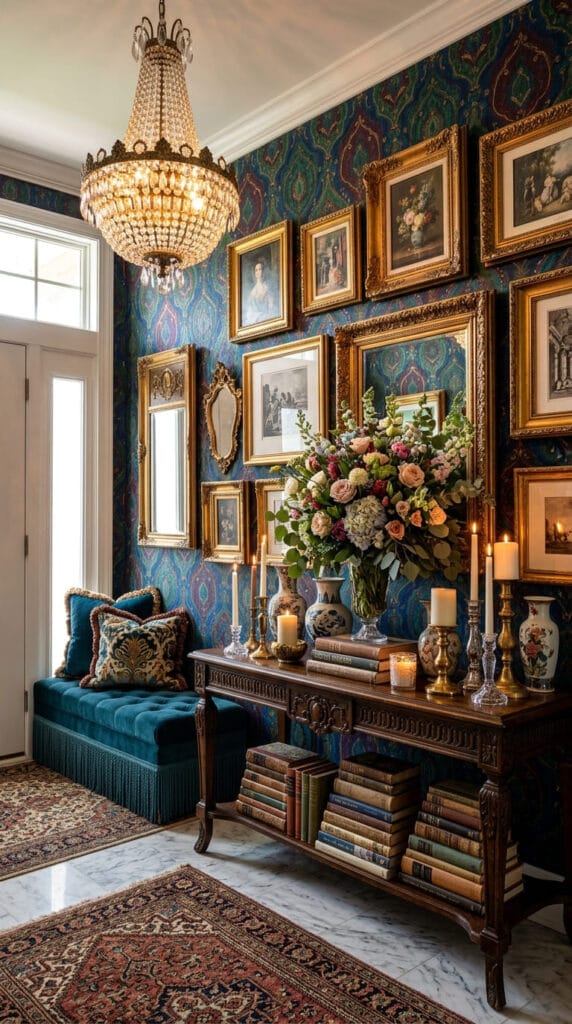
An entryway in a maximalist home declares right from the threshold that creative people who appreciate the aesthetics of past eras live here. Wallpaper with a rich oriental pattern instantly envelops you in warmth, while a massive crystal chandelier on the ceiling makes the gilding on numerous frames shimmer. The secret of this zone lies in the strict symmetry of the console table and thoughtful layering: the books on the lower shelves are arranged not just for storage, but as a solid visual complement to the overall picture.
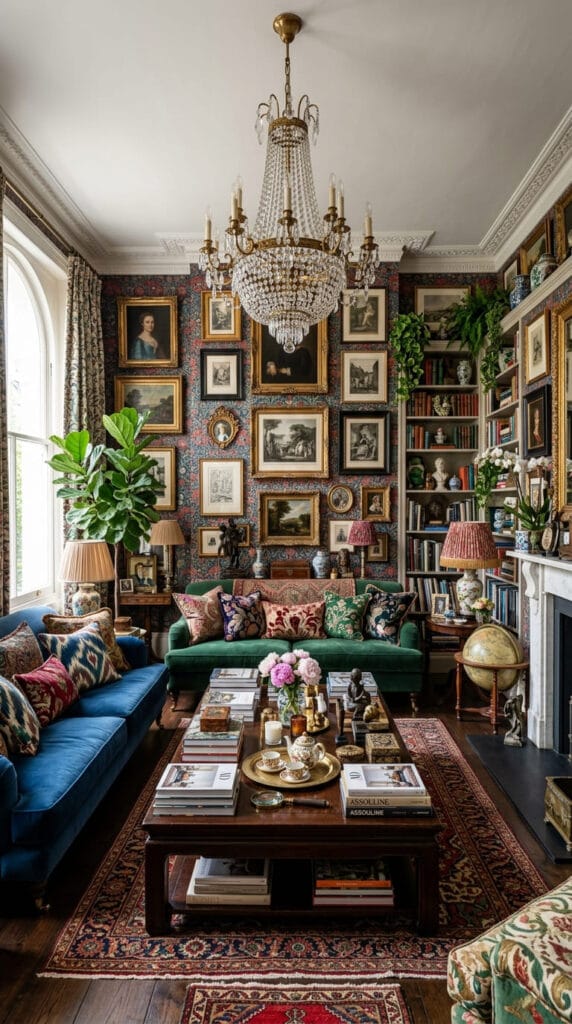
In the living room, maximalism unfolds its scale to the fullest, turning the room into a cozy home salon. Here, a bold combination of colors plays the leading role: the deep blue velvet of one sofa rhymes perfectly with the emerald tone of the other. This entire furniture composition is tied together by an oriental rug with a complex geometric pattern and an endless library wall filled with books and souvenirs. A tall fiddle-leaf fig tree in a pot adds freshness to the interior, balancing the abundance of antique decor.
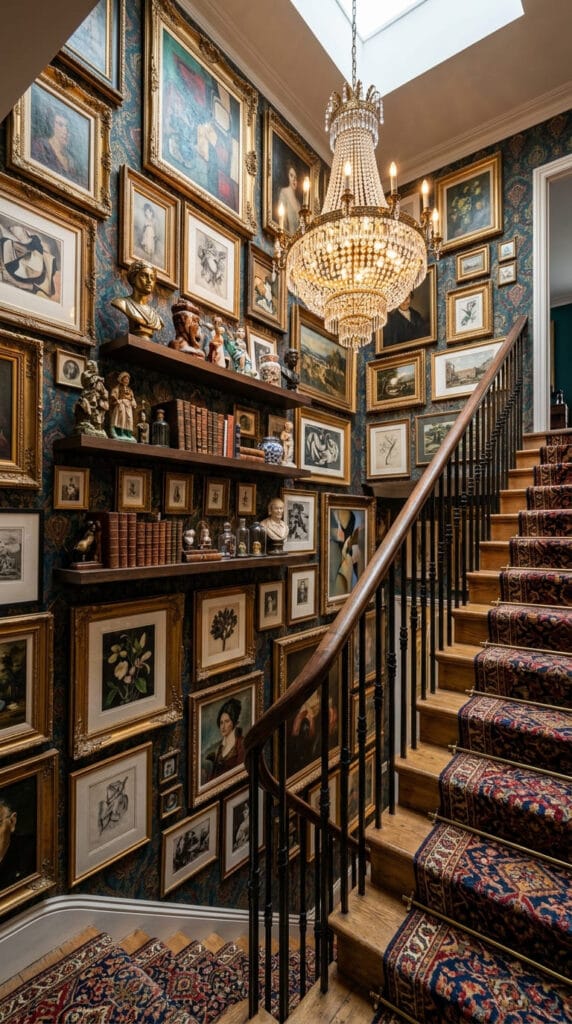
Vertical spaces, such as staircases, are never left empty in this style—they are used as fully fledged exhibition halls. The walls are completely hidden under a dense tapestry-style display of paintings from different eras and styles, unified by a shared noble framing. Small wooden shelves built right in the middle of the frames create additional volume, allowing for a beautiful arrangement of antique leather-bound books, busts, and collectible porcelain, forcing the eye to linger on every detail during the ascent.
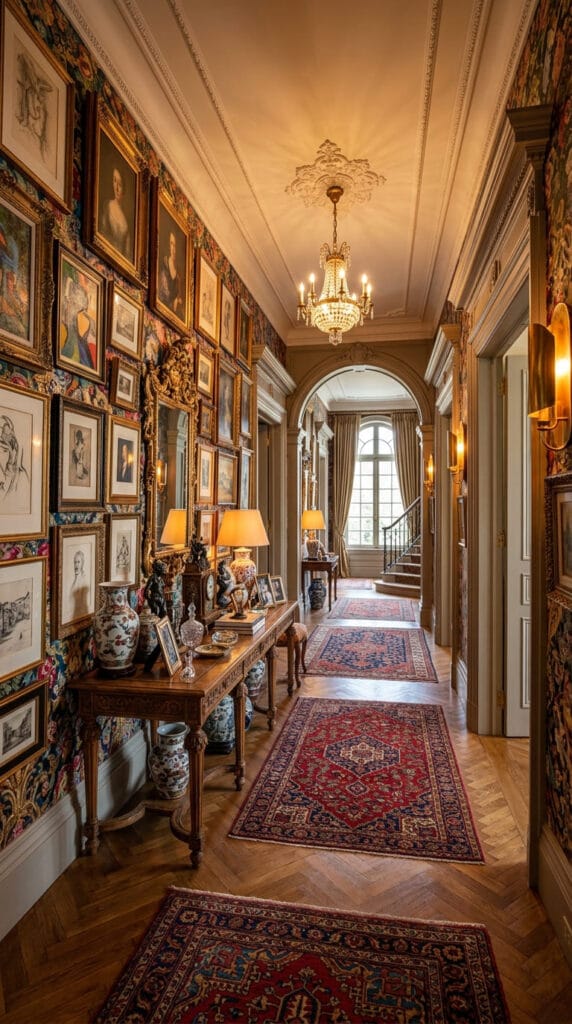
Hallways in maximalism are transformed into enfilades that make you want to stroll for hours, studying the details. Architectural arches and strict door portals structure the long space, keeping it from falling apart into scattered pieces. Repeating elements—Persian carpet runners on the oak parquet, table lamps with fabric lampshades, and delicate Chinese vases on slim consoles—set the right internal rhythm, making the abundance of graphics on the walls feel light and harmonious.
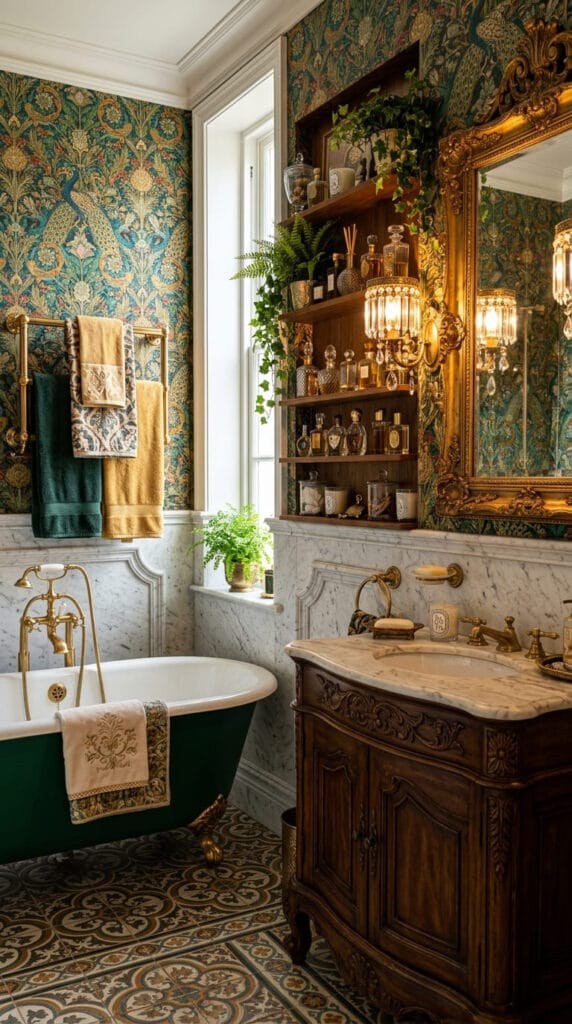
The bathroom proves that maximalism is applicable in absolutely any utilitarian zone. The lower part of the walls is finished with strict white marble, which serves as a calming backdrop for the luxurious wallpaper depicting peacocks. A cast-iron clawfoot tub, painted a deep green on the outside, pairs ideally with the textured, handcrafted wooden vanity. Open shelving filled with delicate crystal perfume bottles, aroma diffusers, and skincare products turns ordinary water procedures into a beautiful ritual.
Advice from Me: How to Avoid Overloading a Maximalist Interior and Prevent Clutter
Maximalism is not a chaotic accumulation of things, but a controlled and highly organized approach to decor. Take one wrong step, and a vibrant interior turns into a junk shop. To prevent this from happening, I recommend using a few of my time-tested rules:
- Use a color or thematic anchor. If you are designing a gallery wall out of dozens of completely different paintings (as seen on our staircases and in the corridors), unify them with a common element. This could be either frames in the same style (for instance, only antiqued gold or only black molding) or a similar color palette within the artworks themselves. A common visual denominator instantly turns chaos into a curated collection.
- Group small decor items on trays and stands. Small objects (candles, bottles, figurines, trinket boxes) should never be scattered all over the surface of a table or shelf. Place them on a beautiful brass, mirrored, or wooden tray. Our brains perceive items on a tray as a single, large unified element rather than a mountain of tiny clutter. This immediately creates a sense of order.
- Leave zones for “visual rest.” Even in the most saturated maximalist interior, there must be surfaces where the eye has nothing to catch onto. This could be a clean white ceiling with strict crown molding, a solid marble wainscoting panel at the bottom of a wall, or simply an open stretch of floor. These pauses are vitally necessary—they emphasize the beauty and value of the adjacent decor, keeping the interior from overwhelming the psyche.
- Transitional Coastal: How to Combine Elegant Classics and Seaside Freshness Throughout the Whole House
- Sleek Scandi: How to Create a Light, Clean, and Cozy Scandinavian Interior Throughout the Whole House
- Equestrian Chic: How to Create an Atmosphere of Noble Estate Elegance and Aristocratic Comfort Throughout the House
- Cabin Chic: How to Create an Alpine Chalet Atmosphere and Secluded Comfort Throughout the Whole House
- Soft Industrial: How to Create an Aesthetic, Warm, and Modern Loft Throughout the Whole House
- Bright Boho: How to Create a Light, Cozy, and Vibrant Interior Throughout the Whole House